


Global WaqfTech Executive AI Academy
When May AI Decide?
in Waqf, Zakat and Islamic Social Finance
Abstract
Artificial intelligence is increasingly capable of classifying,
recommending, predicting and generating outputs that may influence
decisions in Islamic social finance. Yet technical capability does not
itself establish legitimate authority.
This paper examines a prior question that is especially consequential
for waqf, zakat and Islamic social finance institutions: when may AI
support a decision, when must qualified human judgement remain decisive,
and when should delegation to AI be prohibited or tightly constrained?
Using a structured integrative conceptual review, the paper synthesises
contemporary AI-governance scholarship with Shariah governance,
Maqasid al-Shariah, amanah, justice, public interest, harm prevention
and institutional accountability.
It distinguishes computational assistance from normative judgement and
argues that AI should be treated as a means (wasilah), not an independent
bearer of Shariah authority or fiduciary responsibility.
The analysis develops a decision-authority architecture based on five
questions: legitimacy of purpose, nature of the decision, degree of
normative judgement required, severity and reversibility of potential
harm, and adequacy of meaningful human oversight.
Applied to waqf and zakat, the framework shows why functions such as
document retrieval, anomaly detection and administrative drafting may
be delegated more readily than determinations involving waqif intent,
zakat eligibility, beneficiary exclusion, religious rulings or
irreversible allocation decisions.
Keywords:
Artificial intelligence; Shariah governance; Maqasid al-Shariah;
waqf; zakat; Islamic social finance; human oversight;
algorithmic accountability; AI delegation; amanah.
Why This Research Matters
Artificial intelligence is no longer confined to back-office analysis.
It is beginning to shape decisions themselves. Large language models
can retrieve and synthesise rules, classify applications, draft opinions
and generate recommendations. Predictive systems can rank cases, flag
anomalies and forecast outcomes, while automated workflows can initiate
actions at a scale and speed that conventional administration cannot match.
For Islamic social finance institutions, these capabilities may improve
information access, operational efficiency, fraud detection, beneficiary
service and institutional learning.
Yet they expose a more fundamental governance question:
the ability to generate an answer does not, by itself,
confer the authority to decide.
Research Question
Under what conditions may artificial intelligence be used to support
or execute decisions in waqf, zakat and Islamic social finance
institutions without displacing Shariah legitimacy, Maqasid reasoning,
human responsibility and institutional accountability?
AI may assist institutional judgement without inheriting the moral,
fiduciary or Shariah authority of the humans and institutions
responsible for the decision.
Contribution to the Literature
This paper contributes to the literature by developing a
Shariah–Maqasid decision-authority framework for determining when
artificial intelligence may assist, recommend, execute, or should be
restricted from consequential decisions in waqf, zakat and Islamic
social finance institutions.
It distinguishes technical capability from legitimate decision authority
and brings Shariah legitimacy, Maqasid reasoning, amanah, potential harm,
reversibility and meaningful human oversight into the governance of AI
delegation.
Rather than treating Islamic AI ethics primarily as a general collection
of principles, the paper translates these considerations into an
institutional decision logic that can inform governance practice and
provide a foundation for subsequent expert validation and empirical research.
Decision-Authority Logic
Before an institution determines how much authority may be delegated
to an AI-enabled system, five questions need to be considered together.
These factors progressively determine the appropriate level of AI
involvement in the decision.
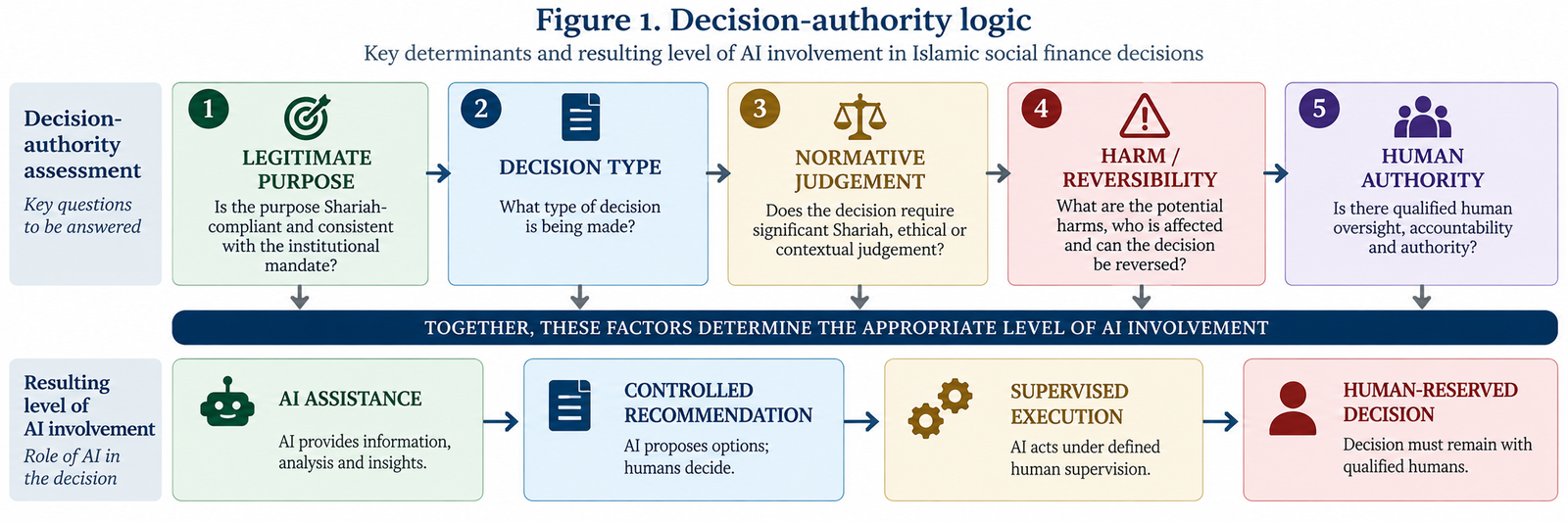
Source: Author’s conceptualisation.
The Five Decision-Authority Tests
1. Legitimacy of Purpose
The first question concerns why AI is being used. The institutional
purpose must be legitimate, consistent with Shariah and aligned with
the institution’s mandate. Technical efficiency cannot legitimise an
otherwise impermissible or institutionally inappropriate objective.
2. Nature of the Decision
Institutions should distinguish administrative, analytical, advisory,
fiduciary, distributive and explicitly religious decisions. The type
of decision affects the degree of authority that may legitimately be
assigned to an AI-supported process.
3. Degree of Normative Judgement
Some decisions depend substantially on factual processing; others
require contextual interpretation, ethical judgement, Shariah reasoning
or the balancing of competing interests. The greater the normative
content of a decision, the stronger the case for retaining qualified
human authority.
4. Harm, Scale and Reversibility
Potential harm must be considered alongside the number and vulnerability
of people affected and whether an erroneous decision can realistically
be reversed.
A reversible administrative recommendation does not carry the same
governance implications as an automated decision that excludes a
vulnerable beneficiary or irreversibly allocates entrusted assets.
5. Meaningful Human Authority
Human oversight cannot be reduced to a person formally approving an
AI-generated recommendation.
Meaningful authority requires an authorised and competent human actor
who has sufficient information, time and institutional power to question,
reject, override, escalate or stop the AI-supported process.
Four Levels of AI Involvement
AI Assistance
AI provides information, retrieval, analysis or insight while humans
retain the decision-making function.
Controlled Recommendation
AI proposes options or recommendations, but an authorised human
evaluates the recommendation and makes the decision.
Supervised Execution
AI may execute defined actions within approved parameters while
remaining subject to meaningful human supervision, monitoring and
intervention.
Human-Reserved Decision
Where religious authority, substantial normative judgement, severe
potential harm, beneficiary vulnerability or irreversible consequences
are involved, the substantive decision remains with appropriately
qualified human authority.
Shariah–Maqasid Governance of AI Decision Authority
The broader conceptual architecture begins with the Shariah–Maqasid
normative foundation and connects institutional context to the
decision-authority tests, permissible AI involvement, governance
safeguards, responsible outcomes and continuous institutional learning.
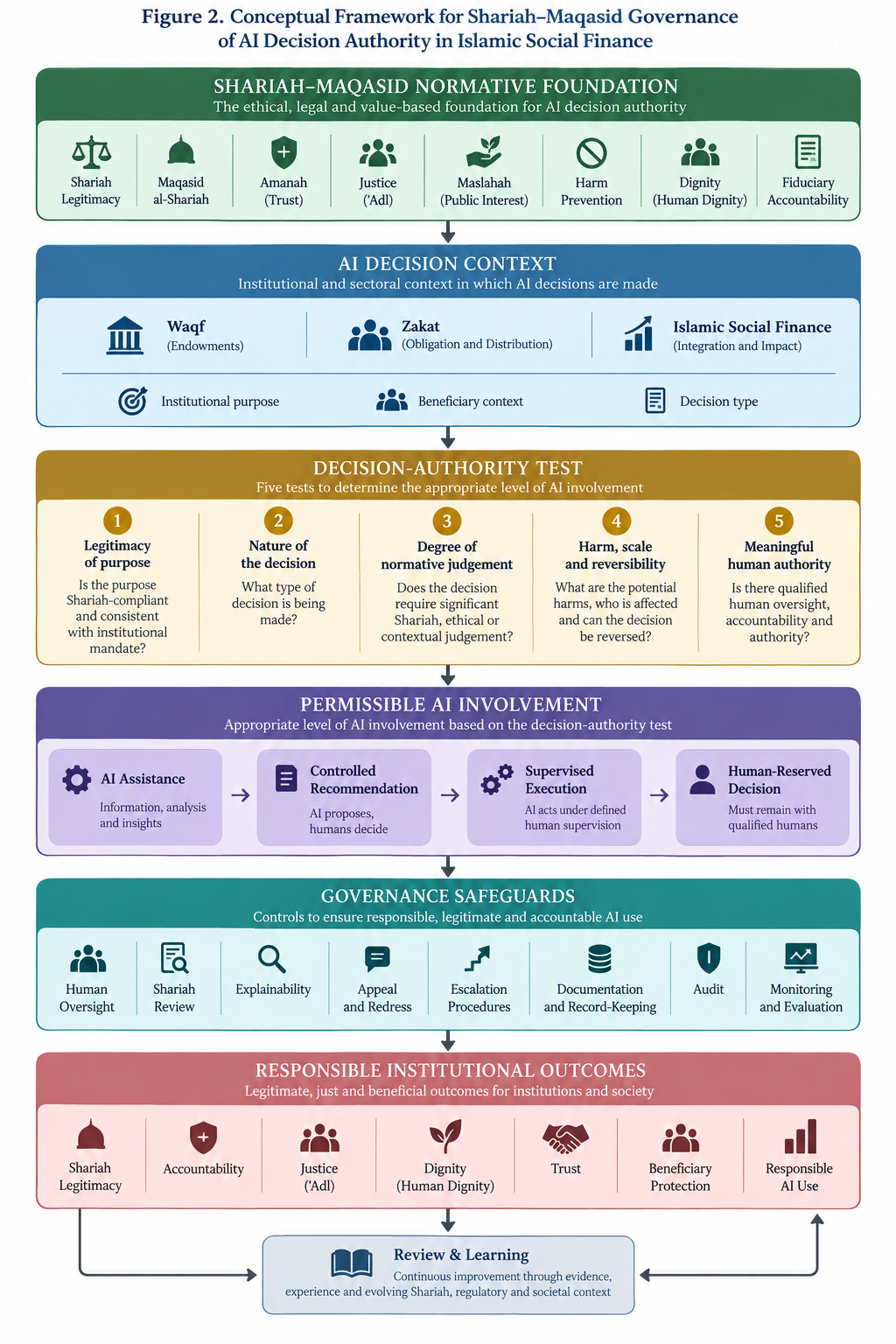
Governance of AI Decision Authority in Islamic Social Finance.
Source: Author’s conceptualisation.
Application to Waqf
AI can support waqf administration in areas such as document retrieval,
asset information management, anomaly detection, forecasting, drafting
and operational analysis.
However, the governance implications change when a decision concerns
the interpretation of waqif conditions, alteration of endowed purposes,
beneficiary rights, preservation or substitution of assets, or other
matters requiring substantive Shariah, fiduciary or contextual judgement.
In such cases, computational assistance should not be confused with
the authority entrusted to trustees, boards, Shariah authorities and
other legitimate institutional actors.
Application to Zakat
Zakat institutions may use AI to improve administrative processes,
identify anomalies, analyse applications, support information retrieval,
forecast demand and assist authorised officers.
Greater caution is required where AI-supported systems influence
eligibility, beneficiary exclusion, prioritisation among vulnerable
applicants or determinations involving contested or context-sensitive
Shariah considerations.
Efficiency in processing cannot replace the institution’s responsibility
for the religious legitimacy, fairness and consequences of its decisions.
Application to Islamic Social Finance and Impact Decisions
The same decision-authority logic extends beyond waqf and zakat.
Islamic social finance institutions increasingly operate across
investment, development finance, philanthropy, impact assessment,
beneficiary services and blended social-finance structures.
AI may strengthen analysis, forecasting, monitoring and institutional
learning in these areas. Yet decisions affecting entrusted capital,
beneficiary interests, social priorities or Shariah-sensitive investment
choices continue to require clearly assigned human and institutional
accountability.
Meaningful Human Oversight
Responsibility remains with the people and institutions to whom it was
entrusted: trustees, boards, Shariah authorities, zakat administrators
and other authorised actors. Adding AI to the decision chain does not
dilute that answerability.
A nominal approval at the end of an automated process is therefore
insufficient.
Meaningful oversight exists only when a qualified and authorised person
has enough information, time, competence and institutional authority
to understand what the system is doing, challenge its output, intervene,
override it and, when necessary, stop the process altogether.
Decision Significance and Governance Intensity
Not every AI-supported activity requires the same level of governance.
Administrative and informational functions may permit comparatively
greater automation where consequences are limited and reversible.
As decisions become more consequential, more normatively complex,
more difficult to reverse, or more significant to vulnerable
beneficiaries, governance intensity should increase accordingly.
The central question is therefore not simply whether AI can perform
a function, but whether the institution can legitimately delegate
that degree of authority while preserving accountability.
Relationship to GF-AIRISF
This paper does not replace or modify the
Governance-First Artificial Intelligence Readiness for Islamic
Social Finance (GF-AIRISF) framework introduced in Research
Paper No. 01.
The two papers address different but complementary institutional
questions.
Research Paper No. 01
Is the institution ready for responsible AI adoption?
Research Paper No. 02
What may AI legitimately be allowed to do?
Together, the two perspectives connect institutional readiness with
the governance of actual AI decision authority.
Research Propositions
The greater the normative and fiduciary significance of an institutional
decision, the lower the legitimate degree of autonomous AI delegation.
Meaningful human oversight positively influences the legitimacy and
accountability of AI-supported decisions in Islamic social finance
institutions.
Shariah and Maqasid review becomes more important as potential harm,
beneficiary vulnerability, decision irreversibility and religious
significance increase.
Institutions that distinguish computational assistance from normative
authority will demonstrate stronger accountability than institutions
that treat AI recommendations as presumptively authoritative.
Appeal, escalation and audit mechanisms positively influence stakeholder
trust in consequential AI-supported decisions.
Preservation of human expert capability positively influences the
long-term sustainability of responsible AI governance.
Implications for Institutional Leaders
The practical implication is not that Islamic social finance institutions
should avoid AI. It is that the authority granted to AI should be
proportionate to the nature and consequences of the decision.
Boards, trustees, Shariah committees and executive leaders should
therefore determine in advance which functions may be automated,
which require human approval, which require specialist or Shariah
review, and which decisions must remain substantively human.
Institutions also require documentation, escalation, appeal, audit,
monitoring and periodic reassessment so that human authority remains
meaningful throughout the AI lifecycle.
Future Research
The framework presented in this paper is conceptual. Future research
should therefore test and refine the decision-authority architecture
through expert validation, comparative institutional studies and
empirical application across different waqf, zakat and Islamic social
finance environments.
Further work may examine how decision classes vary across jurisdictions,
how Shariah governance bodies interpret acceptable levels of AI
delegation, how beneficiaries perceive AI-supported decisions, and
how meaningful human oversight can be assessed in practice.
Conclusion
AI can retrieve, compare, predict, classify and recommend, and in doing
so it can materially improve the information available to responsible
decision-makers.
What it cannot do is inherit the Amanah, Shariah authority or fiduciary
accountability entrusted to human beings and institutions.
The implication is straightforward: as the significance of a decision,
the need for normative judgement, beneficiary vulnerability, potential
harm and irreversibility increase, so too must the strength of human
authority and governance.
AI may assist judgement.
It must not erase responsibility.
Suggested Citation
Mugis, I. A. (2026).
When May AI Decide? Shariah, Maqasid and the Limits of Artificial
Intelligence Delegation in Waqf, Zakat and Islamic Social Finance.
Global WaqfTech Executive AI Academy, Research & Thought Leadership
Series, Paper No. 02.
About the Research Series
The Global WaqfTech Executive AI Academy Research & Thought
Leadership Series advances applied scholarship at the
intersection of artificial intelligence, institutional governance,
Shariah, Maqasid, waqf, zakat and Islamic social finance.
The series supports the development of responsible institutional
approaches to emerging technology while creating a research foundation
for executive learning, policy dialogue and future empirical inquiry.






Leave a Reply