


From Compliance to Authenticity and Impact
Islamic finance has developed increasingly sophisticated systems for establishing Shariah compliance through governance, supervision, review and audit. Yet an important question remains:
Does compliance alone establish that an Islamic financial arrangement is substantively authentic and producing meaningful impact?
A new conceptual paper by Ibrahim Abdul Mugis, President of Awqaf Africa and Journalist & Islamic Social Finance Researcher, examines this question through the proposed Compliance–Authenticity–Impact (CAI) Framework.
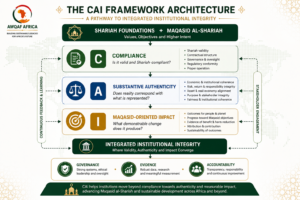
The framework provides an integrated diagnostic architecture for Islamic finance and Islamic social finance, distinguishing three related but analytically different dimensions of institutional integrity.
The Three Dimensions of CAI
1. Compliance — Is it valid and Shariah-compliant?
Compliance forms the foundational layer.
It considers Shariah validity, institutional governance, contractual structure and operation under the relevant Shariah authority and regulatory environment.
The CAI Framework does not seek to replace Shariah boards or qualified juristic judgement. Instead, it begins with the established authority of Shariah governance.
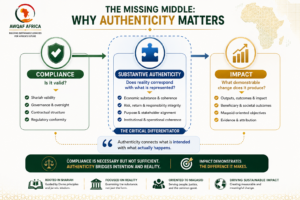
2. Substantive Authenticity — Is it genuine in economic and institutional substance?
This is the proposed “missing middle layer.”
Substantive Authenticity examines whether the actual economic and institutional reality remains materially coherent with the Islamic structure, purpose and institutional character being represented.
The paper proposes six provisional domains for future validation:
Substance–Representation Consistency; Risk–Return and Responsibility Integrity; Asset, Activity and Real-Economy Coherence; Purpose Preservation; Fairness and Stakeholder Integrity; and Institutional Coherence.
The framework therefore does not judge authenticity merely according to how different an Islamic product appears from conventional finance.
Instead, it asks whether the rights, obligations, risks, asset relationships, institutional conduct and purposes represented are substantively reflected in reality.
3. Impact — What demonstrable outcomes does it produce?
The third dimension moves from intention and activity to evidence.
CAI distinguishes between inputs, activities, outputs, outcomes and, where feasible, attributable longer-term impact.
For Islamic social finance institutions in particular, the number of beneficiaries reached, the amount of Zakat distributed or the value of Waqf assets managed should not automatically be described as impact.
The deeper question is:
What actually changed?
Impact is therefore assessed in relation to legitimate institutional objectives and relevant Maqasid al-Shariah.
From Three Dimensions to Integrated Institutional Integrity
The proposed architecture can be expressed as:
Shariah Foundations + Maqasid al-Shariah
↓
Compliance
Validity: Is it valid and Shariah-compliant?
↓
Substantive Authenticity
Coherence: Does reality correspond with what is represented?
↓
Maqasid-Oriented Impact
Outcomes: What demonstrable change does it produce?
↓
Integrated Institutional Integrity
Across the architecture sit three enabling considerations:
Governance • Evidence • Accountability
This reflects the conceptual architecture presented in Figure 1 of the paper.
The Representation–Reality Principle
One of the central propositions introduced by the paper is the Representation–Reality Principle.
The principle proposes that substantive integrity increases where actual economic and institutional behaviour remains materially coherent with the Islamic structure and purpose represented.
This creates a diagnostic space between asking whether something is legally valid and asking whether it ultimately produces good outcomes.
The Asymmetric Non-Substitution Principle
A second major theoretical contribution is the Asymmetric Non-Substitution Principle.
The framework argues that favourable social outcomes cannot independently cure a fundamental Shariah-validity defect.
At the same time, weak outcomes do not automatically invalidate an otherwise valid Shariah arrangement.
In simplified form:
Compliance does not automatically prove Authenticity.
Compliance does not automatically prove Impact.
Authenticity does not automatically prove Impact.
And positive Impact cannot independently establish Shariah validity.
The strongest condition therefore exists when credible evidence is present across Compliance, Authenticity and Impact together.
Applications to Waqf and Zakat
The CAI Framework has potentially important implications for Islamic social finance.
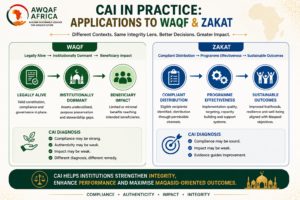
Waqf: Legally Alive, Institutionally Dormant
A Waqf may be validly constituted, preserve its corpus and satisfy relevant governance requirements while its assets remain substantially underutilised and intended beneficiaries receive little recurring benefit.
CAI enables these conditions to be distinguished.
The Waqf could remain strong in Compliance, exhibit weaknesses in Authenticity through purpose-preservation or stewardship gaps, and demonstrate weak Impact in beneficiary outcomes.
Poor performance therefore does not automatically mean that the Waqf itself is invalid.
Zakat: Compliant but Ineffective
Likewise, a Zakat livelihood programme may correctly identify eligible recipients and distribute funds through permissible channels while failing to achieve its stated objective of sustainable livelihood improvement.
Its compliance may remain sound while its impact is weak.
This distinction matters because each diagnosis requires a different response: a compliance failure may require Shariah or legal remediation; an authenticity problem may require institutional or programme redesign; and an impact problem may require improved targeting, implementation and measurement.
Complementing Existing Islamic Finance Frameworks
The CAI Framework is not proposed as a replacement for existing Shariah governance, Maqasid-performance models, Value-Based Intermediation (VBI), VBIAF or social-impact measurement.
Instead, it seeks to provide a common diagnostic architecture capable of distinguishing:
Validity → Substantive Coherence → Demonstrated Outcomes
The paper identifies Malaysia’s Value-Based Intermediation (VBI) as the closest major institutional comparator, while distinguishing CAI through its explicit validity layer, substantive middle layer and asymmetric non-substitution principle.
A Framework for Further Research
CAI Version 1.0 remains a conceptual framework.
The paper proposes three subsequent stages of research:
- formal systematic evidence review;
- modified Delphi expert validation; and
- empirical case studies across Islamic finance and Islamic social finance institutions.
Only following systematic evidence consolidation, qualified Shariah review, expert validation and empirical testing should numerical scoring, certification or comparative institutional ranking be considered.
About the Author
Ibrahim Abdul Mugis
President, Awqaf Africa
Research Paper | CAI Framework Version 1.0 | 2026
Conceptual manuscript for academic review and subsequent expert and empirical validation.CAI_Paper_01_Publication_Grade_Full





Leave a Reply