


AI Is Coming to Waqf and Zakat: Are Islamic Social Finance Institutions Ready?

GF-AIRISF | Governance Before Technology
Artificial intelligence is rapidly moving from experimentation into mainstream institutional use. Across financial services and public institutions, AI is increasingly being applied to data analysis, decision support, automation, risk monitoring, customer engagement and operational processes.
For Waqf, Zakat and Islamic Social Finance (ISF) institutions, this technological transition presents significant opportunities.
AI could potentially strengthen beneficiary assessment, improve administrative efficiency, support asset management, enhance fraud detection, assist impact measurement, improve knowledge management and strengthen institutional decision-making.
But there is a more fundamental question that should come before technological adoption:
Are Islamic social finance institutions institutionally ready to govern AI responsibly?
This question is particularly important because Islamic social finance institutions are not ordinary technology adopters. They operate within distinctive Shariah, fiduciary, social, legal and public-trust responsibilities.
A Waqf institution, for example, must safeguard endowed assets and respect the conditions of the waqif. A Zakat institution must protect beneficiary dignity, ensure appropriate collection and distribution, and preserve confidence in a religiously significant institution.
For these institutions, therefore, AI readiness cannot simply mean having sophisticated software, large datasets or an enthusiastic technology team.
Governance must precede algorithms.
This is the central proposition behind the Governance-First Artificial Intelligence Readiness for Islamic Social Finance (GF-AIRISF) Framework.
Why AI Readiness Requires More Than Technology
Many conventional approaches to AI readiness focus heavily on technological capability.
They ask whether an institution has adequate infrastructure, sufficient data, technical expertise, cybersecurity systems and the financial capacity to deploy AI.
These questions are important—but they are not sufficient for Islamic social finance.
An institution may possess sophisticated technological infrastructure and still be unprepared to answer fundamental questions such as:
- Who is accountable when an AI-assisted decision causes harm?
- Which decisions should never be delegated to automated systems?
- How should Shariah governance apply to AI-assisted processes?
- Are beneficiary data being collected and used legitimately?
- How should bias, explainability and human oversight be addressed?
- How can waqif conditions be protected?
- What happens when an AI system produces an output inconsistent with institutional values or Maqasid?
- Can an institution suspend or reverse an AI-assisted decision when necessary?
These are fundamentally governance questions, not merely technological questions.
GF-AIRISF therefore reframes AI readiness as a multidimensional institutional capability rather than a technology-acquisition exercise.
Introducing GF-AIRISF
The Governance-First Artificial Intelligence Readiness for Islamic Social Finance (GF-AIRISF) framework is proposed as an integrated institutional readiness architecture for organisations operating across:
Waqf • Zakat • Sadaqah • Islamic microfinance • charitable foundations • Islamic development organisations • Islamic social-finance institutions
The framework brings together governance, Shariah and Maqasid, data, technology, human capability, operational processes, legal and stakeholder considerations, and continuous assurance.
Rather than asking simply:
“Can this institution deploy AI?”
GF-AIRISF asks the more important question:
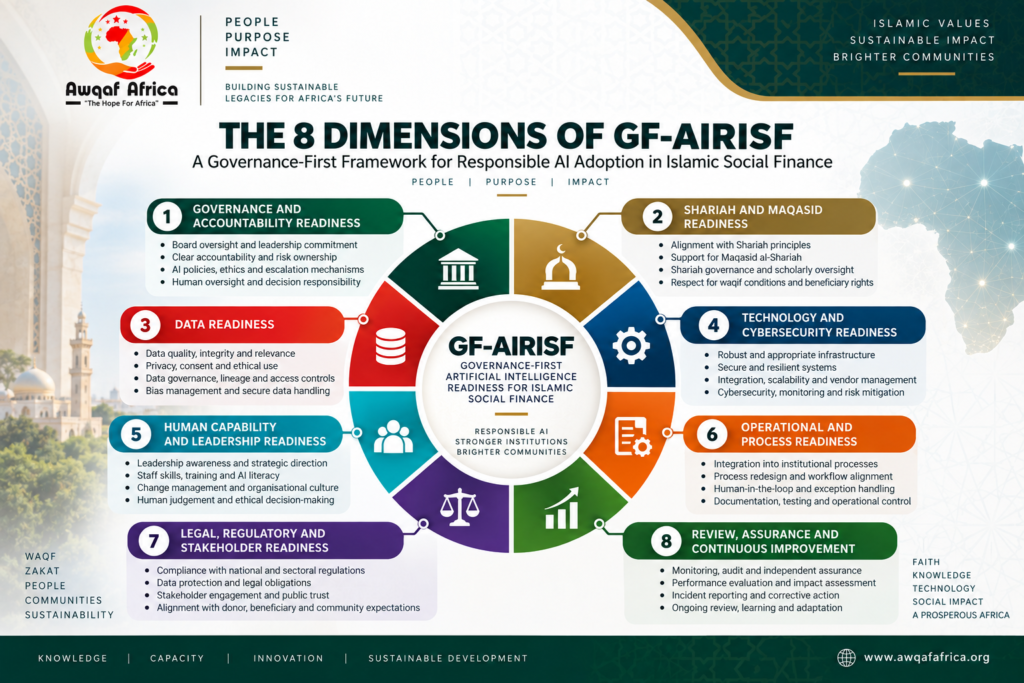
The 8 Dimensions of GF-AIRISF
“Can this institution govern AI responsibly within its religious, fiduciary, social and institutional mandate?”
The Eight Dimensions of GF-AIRISF
The framework proposes eight interdependent dimensions of AI readiness.
1. Governance and Accountability Readiness
The first dimension asks whether the institution has clearly defined responsibility for AI.
It considers board oversight, management accountability, AI policy, risk ownership, escalation procedures and mechanisms for human review.
Before AI becomes embedded in institutional processes, someone must be clearly accountable for what the technology does, where it is used and how failures are addressed.
AI should therefore not operate within an accountability vacuum.
2. Shariah and Maqasid Readiness
Islamic social finance requires a dimension that conventional AI-readiness frameworks generally do not provide.
GF-AIRISF therefore explicitly incorporates Shariah governance and Maqasid al-Shariah.
This dimension considers whether proposed AI applications are consistent with the institution’s religious mandate, whether relevant Shariah oversight exists, and whether technology supports rather than undermines legitimate institutional purposes.
The issue is not simply whether AI itself is permissible.
The deeper question is whether a particular use of AI, within a particular institutional context, respects Shariah requirements, beneficiary rights, waqif conditions and the objectives the institution exists to serve.
3. Data Readiness
AI systems depend heavily on data.
But Islamic social finance institutions may hold highly sensitive information concerning beneficiaries, donors, Waqf assets, financial circumstances and vulnerable communities.
Data readiness therefore includes more than data quantity.
Institutions must consider:
Data quality • Data ownership • Consent • Privacy • Security • Lineage • Bias • Access controls • Retention • Appropriate use
Poor data governance can turn AI from an institutional opportunity into a source of significant ethical, legal and reputational risk.
4. Technology and Cybersecurity Readiness
Institutions must also assess whether their technological infrastructure can support AI securely and reliably.
This includes system architecture, integration capability, vendor management, cybersecurity, access controls, monitoring and resilience.
Importantly, the framework does not assume that every institution needs the most sophisticated AI infrastructure.
Technology should be proportionate to institutional purpose, risk and capability.
The goal is responsible deployment—not technological competition.
5. Human Capability and Leadership Readiness
AI transformation is ultimately a human and institutional challenge.
Boards, executives, Shariah scholars, administrators, technology teams and programme officers need sufficient understanding to make informed decisions about AI.
This does not mean everyone must become a data scientist.
It means institutional leaders should understand enough to ask the right questions, challenge inappropriate recommendations, recognise risks and exercise meaningful oversight.
Human judgement must remain central where religious, ethical, fiduciary or beneficiary-sensitive decisions are involved.
6. Operational and Process Readiness
An AI system cannot simply be inserted into an institution without understanding the processes it will affect.
Institutions need to identify where AI enters a workflow, who reviews its outputs, how decisions are documented, what happens when the system fails and when human intervention is mandatory.
GF-AIRISF therefore examines operational integration, process redesign, human-in-the-loop mechanisms, documentation and exception handling.
Responsible AI requires clearly governed processes before, during and after deployment.
7. Legal, Regulatory and Stakeholder Readiness
Islamic social finance institutions operate within multiple layers of accountability.
These may include national law, financial regulation, charitable or trust law, data-protection requirements, Shariah governance and expectations from beneficiaries, donors, waqifs, regulators and the wider public.
AI adoption must therefore consider not only technical feasibility but also legal legitimacy and stakeholder trust.
An institution that deploys AI without understanding these obligations may create risks that technological performance alone cannot resolve.
8. Review, Assurance and Continuous Improvement
AI readiness does not end when a system is deployed.
Models change. Data change. Regulations evolve. Institutional priorities shift. Unexpected consequences emerge.
Institutions therefore need mechanisms for:
Monitoring • Audit • Review • Incident reporting • Corrective action • Performance evaluation • Shariah reassessment • Continuous improvement
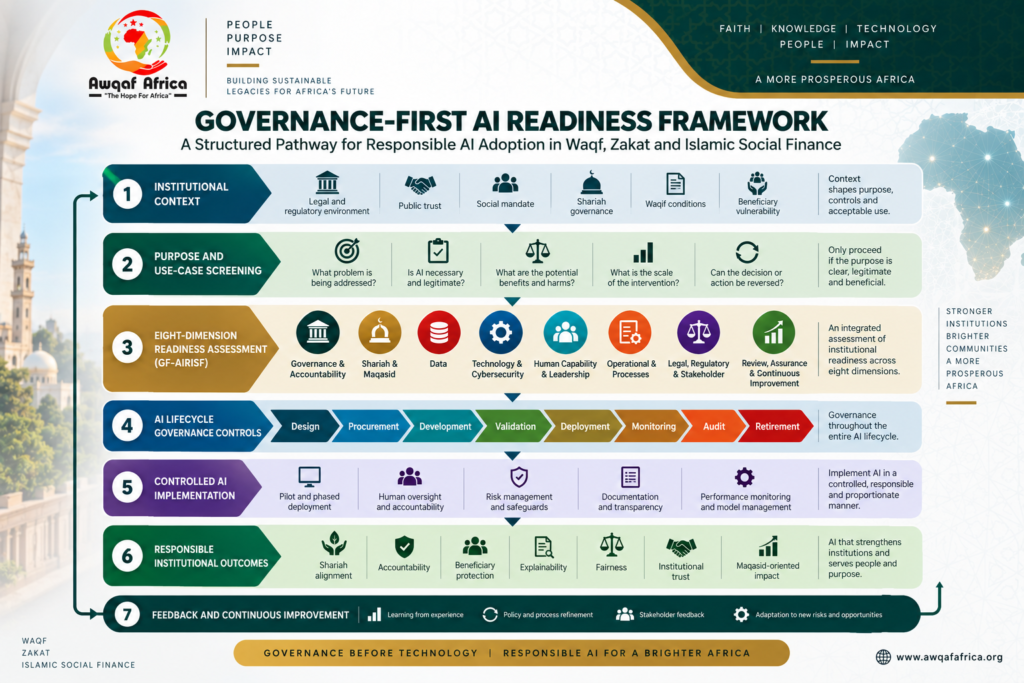
Governance-First AI Readiness Framework
AI governance should be treated as a continuing institutional responsibility rather than a one-time approval exercise.
A Governance-First AI Readiness Architecture
GF-AIRISF organises these dimensions into a broader institutional process.
It begins with the institutional context:
Legal and regulatory environment • Public trust • Social mandate • Shariah governance • Waqif conditions • Beneficiary vulnerability
From there, institutions undertake purpose and use-case screening:
What problem is being addressed?
Is AI necessary and legitimate?
What are the potential benefits and harms?
What is the scale of the intervention?
Can the decision or action be reversed if something goes wrong?
Only after these questions should the institution proceed to the eight-dimensional readiness assessment.
This is followed by lifecycle governance controls covering:
Design → Procurement → Development → Validation → Deployment → Monitoring → Audit → Retirement
The intended result is not AI adoption for its own sake, but controlled AI implementation capable of contributing to responsible institutional outcomes.
Those outcomes include:
Shariah alignment • Accountability • Beneficiary protection • Explainability • Fairness • Institutional trust • Maqasid-oriented impact
The process then feeds back into continuous institutional learning and improvement.
Not Every AI Use Case Carries the Same Risk
An important implication of the framework is that institutions should not govern every AI application identically.
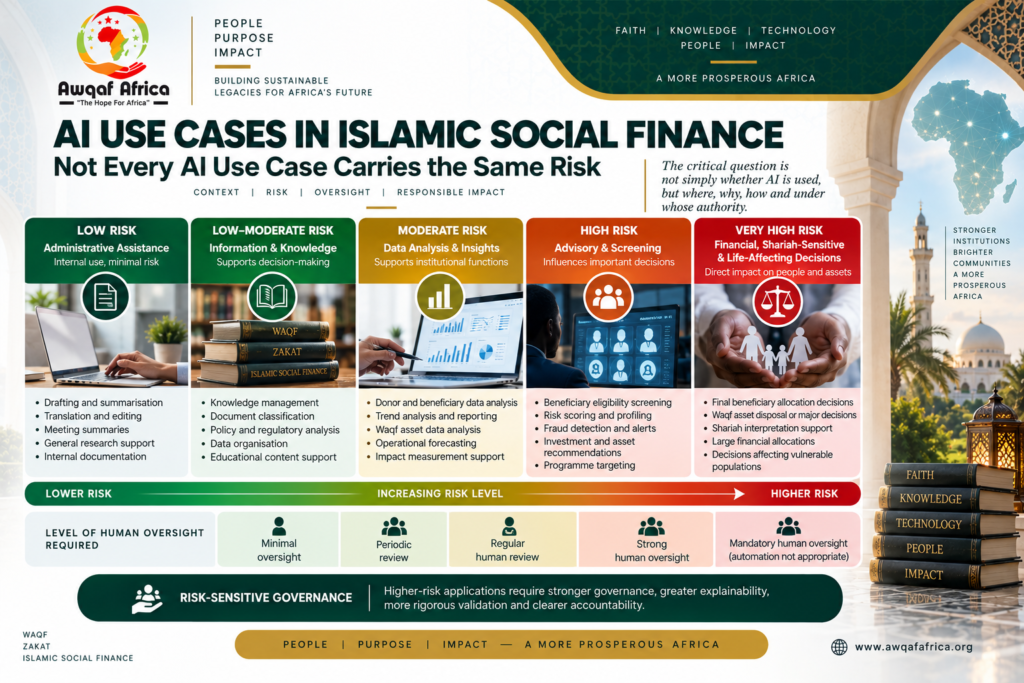
Risk-sensitive AI use cases
Using AI to summarise an internal administrative document is not equivalent to using AI to recommend whether a vulnerable household should receive Zakat assistance.
Similarly, using AI for routine asset-data analysis is different from allowing an automated system to influence a decision affecting a Waqf beneficiary or interpretation of a waqif’s conditions.
GF-AIRISF therefore proposes risk-sensitive governance.
Higher-risk applications should require stronger human oversight, greater explainability, more rigorous validation and clearer accountability.
This is especially important where AI affects:
Beneficiary eligibility • Distribution decisions • Sensitive personal data • Waqf asset decisions • Shariah-sensitive processes • Financial allocation • Vulnerable populations
The question is therefore not simply whether AI is being used.
The critical issue is where, why, how and under whose authority it is being used.
From AI Experimentation to Responsible Institutional Intelligence
The paper also proposes a five-level maturity model for Islamic social finance institutions.
Level 1 — Unaware
AI use is minimal or poorly understood, with little formal governance or institutional awareness.
Level 2 — Experimental
Individual departments or staff begin experimenting with AI, but governance remains fragmented or informal.
Level 3 — Governed
The institution establishes policies, accountability, risk controls and appropriate oversight.
Level 4 — Integrated
AI becomes responsibly integrated into selected institutional processes, supported by governance, capable staff and monitoring.
Level 5 — Responsible Institutional Intelligence
AI contributes to institutional decision-making and service delivery within a mature system of governance, Shariah alignment, accountability, human judgement and continuous improvement.
Crucially, institutional maturity should not be measured by the quantity of AI deployed.
A highly mature institution may deliberately decide not to automate certain decisions.
That decision may itself demonstrate stronger AI readiness than indiscriminate adoption.
The highest level of readiness is therefore not maximum automation.
It is responsible institutional intelligence.
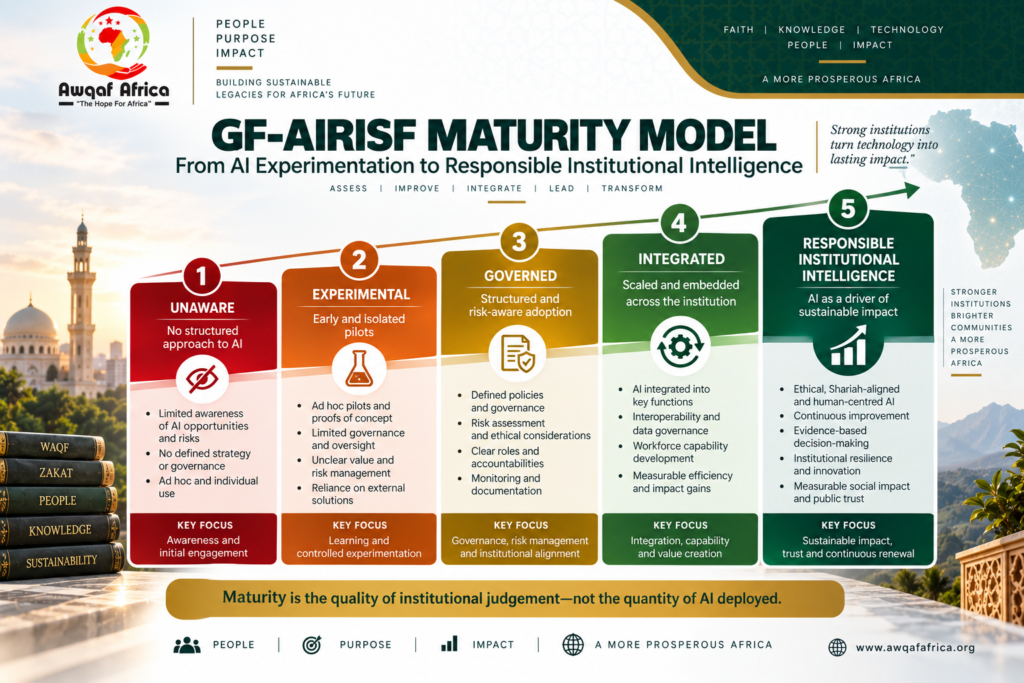
GF-AIRISF Maturity Model
What This Means for Waqf Institutions
For Waqf institutions, AI may create opportunities in areas such as asset management, documentation, portfolio analysis, predictive maintenance, beneficiary services and impact monitoring.
But Waqf introduces distinctive responsibilities.
The institution must consider whether AI use respects:
Waqif conditions • Preservation of endowed assets • Fiduciary responsibility • Beneficiary interests • Shariah governance • Long-term institutional purpose
Technology cannot be allowed to obscure these responsibilities.
AI should strengthen stewardship—not weaken it.
What This Means for Zakat Institutions
AI may similarly assist Zakat institutions with administration, beneficiary identification, fraud detection, service delivery, data analysis and impact measurement.
However, beneficiary assessment can involve highly sensitive socioeconomic information and decisions affecting vulnerable individuals and households.
Efficiency alone is therefore insufficient.
AI-supported Zakat systems must preserve human dignity, fairness, appropriate human oversight, privacy, accountability and Shariah legitimacy.
A system that distributes assistance faster but undermines beneficiary dignity or creates unaccountable exclusion cannot simply be described as successful AI transformation.
Governance Before Technology
The central argument of GF-AIRISF is straightforward:
Governance must precede algorithms.
Islamic social finance institutions should resist the temptation to begin their AI journey by asking:
Which AI platform should we buy?
or:
Which processes can we automate?
The first questions should instead be:
What institutional problem are we trying to solve?
Is AI appropriate for solving it?
What religious, ethical, legal and fiduciary responsibilities are involved?
Who will remain accountable?
How will beneficiaries be protected?
How will the system be reviewed, challenged or stopped?
Only after these questions are addressed should technological deployment proceed.
Toward a Responsible AI Future for Islamic Social Finance
Artificial intelligence offers significant possibilities for Waqf, Zakat and Islamic social finance.
But technological sophistication without institutional readiness can amplify existing weaknesses rather than solve them.
For institutions entrusted with religious obligations, charitable assets, sensitive data and vulnerable beneficiaries, the challenge is therefore not simply to become AI-enabled.
The challenge is to become AI-ready, governance-ready and institutionally responsible.
GF-AIRISF offers a starting architecture for that journey.
The framework remains conceptual and requires further validation. The next research stages identified in the paper include systematic evidence review, expert validation, case studies, indicator refinement and the development of practical assessment instruments.
The objective is not to create another technology checklist.
It is to help build Islamic social finance institutions capable of using emerging technologies while preserving the principles, responsibilities and public trust that give those institutions their legitimacy.
The future of Islamic social finance should not be technology first. It should be governance first, purpose driven, Shariah aligned and human centred.
About the Author
Ibrahim Abdul Mugis is President of Awqaf Africa and is affiliated with the Global WaqfTech Executive AI Academy.
His research interests include Islamic social finance, Waqf and Zakat institutional development, AI governance, WaqfTech, Maqasid-oriented institutional transformation and sustainable development.
📄 Read the Full Research Paper
Governance Before Technology: An Artificial Intelligence Readiness Framework for Waqf, Zakat and Islamic Social Finance Institutions
GF-AIRISF — Governance-First Artificial Intelligence Readiness for Islamic Social Finance
Research Paper • September 2026
[DOWNLOAD FULL PAPER — PDF]
🌍 Continue the Conversation
Awqaf Africa is advancing research, institutional capacity, innovation and sustainable development across Waqf, Zakat, Islamic Social Finance and WaqfTech in Africa and beyond.
💬 Join the Awqaf Africa WhatsApp Community:
Join the Community
Awqaf Africa
Building Sustainable Legacies for Africa’s Future





Leave a Reply