


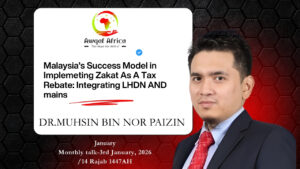
On Saturday, 3rd January 2026 (14 Rajab 1447 AH), Awqaf Africa hosted its January Monthly Talk, focusing on Zakat as a Tax Rebate in Malaysia: how this successful model can inspire African countries to strengthen Islamic finance and compliance.
This flagship knowledge-sharing session, titled:
“Malaysia’s Success Model in Implementing Zakat as a Tax Rebate: Integrating LHDN and MAINS,”
was led by Dr. Muhsin bin Nor Paizin, a distinguished Malaysian zakat practitioner and policy expert. Over the years, Dr. Muhsin has bridged zakat administration, institutional performance, research, and human capital development, offering practical lessons for global audiences.
Watch the full session on YouTube
A Global Session with Unprecedented Engagement
The session began at 10:00 PM Malaysian time and 3:00 PM Nigeria time, allowing broad participation across Africa, Asia, and beyond.
Interest exceeded expectations:
- 4,200 participants registered – the largest in Awqaf Africa’s history.
- Over 250 participants joined live via Google Meet.
- The YouTube livestream attracted 164+ views, showing growing global appetite for practical, policy-ready Islamic social finance models.
This record-breaking engagement demonstrates Africa’s keen interest in learning from Malaysia’s experience with Zakat as a Tax Rebate in Malaysia.
Strategic Institutional Presence and Global Recognition
The session welcomed Rizal Kamaruzaman, Secretary to the General Secretary of the World Zakat and Waqf Forum (WZWF). His participation underscored the global relevance of Malaysia’s zakat-tax model and reinforced Awqaf Africa’s credibility as a platform for serious policy discussions.
For more on Awqaf Africa initiatives, visit Awqaf Africa Projects.
Leadership, Teams, and the Spirit of The Hope for Africa
Strong internal alignment was evident:
- Ibrahim Abdul Mugis, President of Awqaf Africa, affirmed leadership commitment to knowledge-driven institutional growth.
- Country Supervisors from across Africa shared perspectives and explored how to adapt lessons locally.
- The Creative Department Team ensured seamless coordination and delivery.
Together, the leadership, supervisors, and technical teams embodied the spirit of The Hope for Africa — collaboration rooted in shared responsibility.
Understanding Zakat as a Tax Rebate in Malaysia: From Challenge to Harmonisation
A key challenge addressed during the session was the coexistence of religious zakat obligations and civil tax responsibilities.
Rather than creating tension, Malaysia harmonised these systems. Dr. Muhsin explained that:
Clear legislation, institutional trust, and administrative discipline allowed zakat and tax to function as complementary systems.
Under Section 6A(3) of the Income Tax Act 1967, individuals paying zakat to authorized Islamic institutions receive direct tax rebates.
Employer-level integration simplifies compliance while protecting data confidentiality.
This approach has strengthened public trust, improved compliance, and elevated the credibility of zakat institutions — key lessons for African nations seeking to adopt similar models.
Interactive Engagement and Collective Reflection
The session encouraged active participation. Attendees asked five policy-oriented questions, covering:
- Corporate zakat treatment
- Governance structures
- Adaptability for African contexts
The dialogue demonstrated not only attentiveness but also willingness to adapt Malaysia’s model for Africa’s unique environment.
Why This Session Matters for Africa
Malaysia’s success with Zakat as a Tax Rebate in Malaysia shows that:
Governance, professionalism, and legal clarity are key to success.
African countries can use this model to strengthen zakat compliance, build institutional trust, and position zakat as a driver of national development.
This aligns perfectly with Awqaf Africa’s mission to elevate zakat and waqf institutions across the continent.
A Defining Chapter for Awqaf Africa
With record-breaking registration, global participation, high-level institutional presence, and strong internal leadership, the January 2026 Monthly Talk marked a defining chapter in Awqaf Africa’s journey.
More than an event, it was a statement of intent:
The Hope for Africa is not merely discussed — it is intentionally built through knowledge, unity, and action.
Awqaf Africa — The Hope for Africa

Awqaf Africa is a prominent organization dedicated to empowering communities across the African continent. Established to foster sustainable development and social welfare, Awqaf Africa focuses on harnessing the potential of endowments (awqaf) to drive positive change. Through strategic initiatives, partnerships, and impactful projects, Awqaf Africa endeavors to address socio-economic challenges and promote prosperity within African societies.
- Choose your favourite cause
- Register to our website !
- Donate the amount you like
- Stay tuned about cause





Leave a Reply