


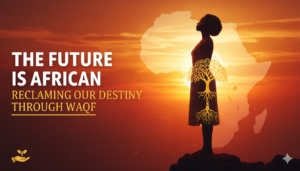
When President John Dramani Mahama stood before the United Nations in 2024 and declared boldly, “The Future is African,” he echoed not just a political vision but a spiritual and economic reality waiting to be unlocked. Africa, with its vast arable land, youthful population, and cultural resilience, is uniquely positioned to lead the world into a new era of inclusive growth. But to do so, it must draw from its own timeless institutions — none more potent than Waqf (endowment).
Waqf as Africa’s Development Engine
From the earliest centuries of Islam, waqf financed schools, hospitals, wells, caravanserai, and even supported widows and orphans. It was the grassroots economy of the people — sustainable, perpetual, and inclusive. Africa today stands in dire need of such a system, not as charity but as a vehicle of empowerment.
The Qur’an reminds us:
> لَن تَنَالُوا الْبِرَّ حَتَّى تُنفِقُوا مِمَّا تُحِبُّونَ
“You will never attain righteousness until you spend from that which you love.” (Qur’an 3:92)
Waqf is this very spending — a sacrifice that outlives us, channeling private wealth into public good.
And again:
> وَتَعَاوَنُوا عَلَى الْبِرِّ وَالتَّقْوَىٰ وَلَا تَعَاوَنُوا عَلَى الْإِثْمِ وَالْعُدْوَانِ
“And cooperate with one another in goodness and righteousness, and do not cooperate in sin and aggression.” (Qur’an 5:2)
Here lies the spirit of waqf: collective cooperation for long-term welfare.
Prophetic Guidance for Perpetual Benefit
The Prophet ﷺ gave us clear direction:
> إِذَا مَاتَ الإِنْسَانُ انْقَطَعَ عَمَلُهُ إِلَّا مِنْ ثَلاثَةٍ: صَدَقَةٍ جَارِيَةٍ، أَوْ عِلْمٍ يُنْتَفَعُ بِهِ، أَوْ وَلَدٍ صَالِحٍ يَدْعُو لَهُ
“When a person dies, his deeds come to an end except from three: a continuing charity, knowledge that benefits, or a righteous child who prays for him.” (Sahih Muslim)
Waqf is sadaqah jariyah — the lifeline of our societies.
The Prophet ﷺ also said:
> خَيْرُ النَّاسِ أَنْفَعُهُمْ لِلنَّاسِ
“The best of people are those who are most beneficial to others.” (al-Mu‘jam al-Awsaṭ)
And he warned against neglecting the vulnerable:
> لَيْسَ مِنَّا مَنْ لَمْ يَرْحَمْ صَغِيرَنَا، وَيُوَقِّرْ كَبِيرَنَا
“He is not one of us who does not show mercy to our young and respect to our elders.” (Sunan al-Tirmidhi)
From the Imams: Africa and Asia’s Juristic Roots
Imam al-Shāfiʿī emphasized the need for clarity in contracts and trusts, making waqf a structured institution that transcends generations. Imam Mālik, whose school flourished in Africa, saw community welfare as integral to faith, and through his al-Muwatta’, reinforced the idea that communal resources must always uplift the poor and protect dignity.
Together, their insights offer Africa and Asia a juristic bridge to reimagine waqf for today’s challenges.
A Story from Kejetia Market
Consider Amina, a tomato seller in Kumasi’s bustling Kejetia market. Every day, she wakes before dawn, balancing a basket on her head to earn just enough for her children’s school fees and food. When she falls sick, her stall closes, her income stops, and her family suffers.
Now imagine if a waqf-funded clinic stood nearby, offering her free healthcare. Or if a waqf-backed microfinance scheme gave her access to interest-free loans to expand her small business. Imagine a waqf-supported school where her children could learn without fear of being sent home for unpaid fees.
This is not theory. It is the lived reality of millions of Africans. And it is exactly where waqf can turn hardship into hope.
President Mahama’s declaration is more than rhetoric. If the future is African, then its foundations must be African-led solutions rooted in our faith and traditions. Waqf can be that instrument — mobilizing wealth, sustaining dignity, and shaping a future where Africa does not just survive but leads.
As Imam al-Shāfiʿī taught us to structure, and Imam Mālik taught us to ground our practice in community, we must now rise to make waqf the heartbeat of Africa’s renaissance.
References & Further Reading
- The Qur’an 3:92, 5:2
- Sahih Muslim, Sahih Bukhari, Sunan al-Tirmidhi, al-Mu‘jam al-Awsaṭ
- Al-Muwatta’ of Imam Mālik
- Al-Umm by Imam al-Shāfiʿī
- President John Mahama’s UNGA Speech, 2024




Leave a Reply